

Claude Fable 5 returned as a globally available premium model on native Claude surfaces on July 1. It remains an expensive, heavily guarded escalation lane—not a default value model.
Current recommendation: start routine Claude workloads with Sonnet 5, use Opus 5 for premium review, and test Fable only when Opus is demonstrably insufficient.
July 9 access note: GPT-5.6 is now generally available; the current GPT-5.6 guide separates its standard access and Trusted Access from Fable’s restored availability and Mythos trusted access. This page remains the canonical Fable buying and guardrail reference.
For the dated export-control reversal and the role of Sonnet 5 as Claude’s default lane, read Fable 5 Returns as Claude Sonnet 5 Becomes Default.
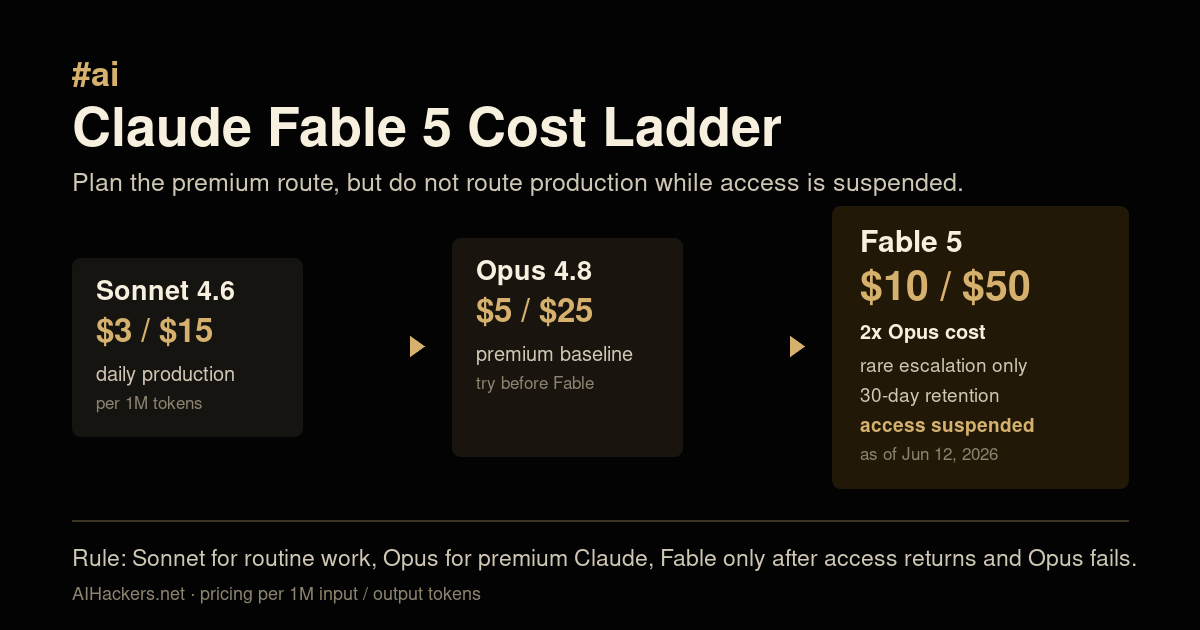
Use Opus 5 first for most premium Claude work. Fable is 2x Opus pricing.
Use Sonnet 5 for routine production coding, agent workflows, summarization, and high-volume automation where cost matters.
Compare GPT-5.5, Kimi, Gemini, MiniMax, and GLM when ecosystem fit, cached-input economics, long-context cost, coding-tool support, or lower-cost overflow matters more than Claude-specific behavior.
Do not default to Fable for cybersecurity, biology, or chemistry workflows unless fallback/refusal behavior is acceptable or your organization has approved trusted access.
Timeline
| Date | Source-labeled status |
|---|---|
| June 9, 2026 | Anthropic launched Fable 5 as the generally available Mythos-class model and kept Mythos 5 limited to approved Project Glasswing customers. Anthropic’s API docs listed the same $10/$50 pricing, 1M context window, 128K output cap, refusal handling, fallback paths, and a 30-day minimum retention rule. |
| June 12, 2026 | Anthropic said a US government directive required suspending Fable/Mythos access for foreign nationals and that compliance meant removing both models for all customers. Anthropic also said the directive did not provide specific details and that the government had given only verbal evidence of a narrow, non-universal jailbreak. |
| June 13, 2026 | WIRED and The Verge reported the practical all-customer shutdown and repeated Anthropic’s disagreement with the technical basis for recalling the models. |
| June 14-15, 2026 | The freefable.org open letter, dated June 14, argued the controls were unjustified and said Mythos-class models are strong at finding flaws but not uniquely strong. WIRED reported on June 15 that security researchers had sent the letter to officials. |
| June 15, 2026 | WIRED reported that Anthropic leaders met officials in Washington and that talks ended without export controls being lifted. WIRED also reported, citing people briefed on the matter, that Amazon CEO Andy Jassy called Treasury secretary Scott Bessent about alleged vulnerabilities; The Information first reported Jassy’s conversation with the administration. |
| June 15, 2026 | WIRED reported that White House officials asked the NSA to review the vulnerability claims and that the NSA believed it was possible to strip away Fable 5’s guardrails. WIRED also quoted Cohere CEO Aidan Gomez warning that AI labs should not be naive about the government’s willingness to act. |
| June 17, 2026 | The Verge reported that the export-control basis remained unclear and that experts saw the action as an unsettled, possibly unprecedented use of export controls against remote AI-model access. |
| June 24-26, 2026 | Business Insider reported that Fable 5 had later been restored with nationality-based controls and enhanced onboarding checks. Anthropic’s public suspension statement remained live, and the Claude pricing/docs pages still listed Fable/Mythos pricing and availability language. Treat availability as account-specific until Anthropic publishes a clear replacement status page or your console confirms access. |
| June 30-July 1, 2026 | Anthropic said the export controls were lifted, restored Fable globally on native Claude surfaces from July 1, and restored Mythos to a set of approved US organizations. Cloud-provider re-enablement remains in progress. |
Source precision note: the public record is uneven. The only primary public directive detail AIHackers has is Anthropic’s June 12 statement. White House, Commerce, NSA, Jassy/Treasury, and process details are press-reported claims, not a public directive text reviewed here.
Current API Cost Table
Prices are per 1 million tokens unless noted. Sonnet 5 introductory pricing runs through August 31, 2026.
| Model | Input | Output | Batch input/output | Practical read |
|---|---|---|---|---|
| Claude Fable 5 | $10 | $50 | $5 / $25 | Restored guarded escalation; not a default lane |
| Claude Opus 5 | $5 | $25 | $2.50 / $12.50 | Current premium Claude baseline |
| Claude Sonnet 5 | $2 introductory; $3 standard | $10 introductory; $15 standard | Verify current pricing docs | Default Claude production test |
| GPT-5.5 standard, short context | $5 | $30 | $2.50 / $15 | OpenAI premium standard lane |
| GPT-5.5 standard, long context | $10 | $45 | $5 / $22.50 | Similar input cost to Fable, lower output cost |
| GPT-5.5 Pro, short context | $30 | $180 | $15 / $90 | Much more expensive than Fable |
For a 100K-input / 20K-output request:
| Model | Approx cost |
|---|---|
| Claude Sonnet 5 | $0.40 introductory / $0.60 standard |
| Claude Opus 5 | $1.00 |
| GPT-5.5 standard short context | $1.10 |
| GPT-5.5 standard long context | $1.90 |
| Claude Fable 5 | $2.00 |
| GPT-5.5 Pro short context | $6.60 |
The simple rule: Fable is 2x Opus, 5x Sonnet 5 at the introductory rate, about 3.3x Sonnet 5 at the standard rate, 2x GPT-5.5 short-context input, and about 1.7x GPT-5.5 short-context output. Against GPT-5.5 long context, Fable matches input pricing and is slightly higher on output. Against GPT-5.5 Pro, Fable is cheaper, but that does not make it a value model.
What Fable 5 Actually Is
Anthropic launched Fable 5 as a generally available version of its Mythos-class model, with safeguards added for public release. On June 12, Anthropic disabled Fable and Mythos for all customers to comply with a US government directive. Anthropic said on June 30 that the controls had been lifted and restored Fable globally from July 1. Your account, plan, usage-credit settings, cloud provider, and region still determine whether a particular route is usable.
Mythos 5 is the same underlying capability class without those Fable safety classifiers in some areas, but it was restricted to Project Glasswing and approved trusted-access customers before the suspension.
The API shape matters:
- Fable 5 and Mythos 5 use a 1M token context window by default and support up to 128K output tokens.
- Fable 5 is generally available, but provider, project, region, and plan entitlements still require verification.
- Mythos 5 remains a trusted-access path and was restored only to a set of approved US organizations.
- Fable 5 can return
stop_reason: "refusal"as a successful HTTP 200 response. - Anthropic documents fallback paths to retry on another Claude model.
- Fable 5 and Mythos 5 carry a 30-day minimum retention and are not available under zero-data-retention terms.
That last point is a deployment blocker for some teams. If your workload requires zero data retention, Fable should not be in the path until your legal/security review says otherwise.
How To Read The Benchmark Claims
Vendor-reported claims
Anthropic says Fable 5 has its biggest lead on longer and more complex tasks, including software engineering, knowledge work, vision, scientific research, memory, and long-context work. Launch coverage summarized Anthropic’s guardrail data as roughly 95% of Fable sessions running without Opus fallback, which implies a less-than-5% fallback rate on average. Treat that as a launch-average vendor claim, not a prediction for cyber, bio, chemistry, or model-development workloads.
Use those as Anthropic claims, not independent rankings.
Customer-reported claims
The launch post includes customer and partner reports from coding, finance, legal, spreadsheet, and research workflows. These are useful because they describe real workloads, but they are still selected launch testimonials. Do not turn them into blanket claims like “Fable is best for all coding.”
Independent evidence and remaining gaps
Artificial Analysis now reports Opus 5 max ahead of Fable on both its Intelligence Index and AA-Briefcase, with lower cost per task. On AA-Briefcase, Opus 5 high narrowly exceeded Fable at $10.41 per task versus Fable’s $22.30. That is meaningful independent evidence for trying Opus 5 first, but it is still one benchmark provider’s harness rather than an AIHackers reproduction.
What is still missing:
- Third-party coding evals with reproducible prompts and token accounting.
- Real fallback/refusal frequency by domain, not just launch-average session rates.
- Cost-per-task tests: bug fix, refactor, architecture review, long-context analysis, vision reconstruction, and agentic coding run.
- Trusted-access clarity for organizations that need cyber or life-science capability without broad false positives.
Until that exists and your target route has been tested, Fable belongs in the guarded-escalation bucket, not the default production-routing bucket.
The Guardrail Problem
Fable’s public release includes classifiers around cybersecurity, biology, chemistry, and distillation-like use cases. Anthropic documents fallback and refusal paths; the exact fallback depends on the route and current configuration.
This has already created friction. TechCrunch reported cybersecurity researchers seeing broad guardrail triggers, including complaints that code review and secure-code prompts could be downgraded. WIRED reported a separate June 11 walkback: Anthropic moved away from invisible safeguards for some frontier-AI-development cases and said users would be told when a prompt is refused or rerouted.
The buying implication is simple: if your workflow lives near cyber, bio, chemistry, model development, or safety research, do not plan around Fable on benchmark claims alone. If your account has access, test the actual prompts you need, log fallback behavior, and decide whether the configured fallback is acceptable.
Decision Framework
Step 1: Start with Sonnet 5
Use Sonnet for routine coding, summarization, tool use, support automation, lightweight agent work, and high-volume production. Its introductory $2/$10 rate runs through August 31, then becomes $3/$15. Re-count prompts because the new tokenizer can produce more tokens for equivalent text.
Step 2: Escalate to Opus 5
Move to Opus 5 when Sonnet fails on architecture, multi-file reasoning, complex debugging, hard review, or long-horizon agent tasks. Start at high effort and raise it only when task-level evidence justifies the added time and tokens.
Step 3: Do not escalate to Fable/Mythos by default
Do not send production workloads to Fable 5 or Mythos 5 unless your target plan and route have confirmed access, usage credits and cloud/region settings are ready, your legal/security team approves the retention and guardrail constraints, and your prompts pass fallback/refusal tests. Keep the historical use cases below as re-entry tests:
- A multi-day migration plan where one missed dependency is expensive.
- Screenshot-to-code or vision reconstruction where lower models lose structure.
- Scientific or financial analysis where the answer will be reviewed but the reasoning lift is valuable.
- Long-horizon autonomous coding where Opus stalls or loops.
Step 4: Keep live alternatives active
Compare the live lane that fits the workload:
- GPT-5.5 when your stack is OpenAI-native, cached-input economics dominate, long-context pricing fits, or Codex tooling matters.
- Kimi when you need a lower-cost coding API lane and Kimi’s current model, quota, and data terms fit.
- Gemini when high-context analysis, document work, or Google tooling is the better fit.
- MiniMax M3 when you want to test a newer 1M-context coding-agent lane with Token Plan or PAYG economics.
- GLM-5.2 when you need a low-cost supported-tool coding lane for overflow and arbitration.
Step 5: Avoid Fable when the constraints do not fit
Avoid Fable/Mythos for:
- Zero-data-retention requirements.
- Sensitive customer data without explicit approval.
- Cybersecurity, biology, or chemistry workflows where fallback breaks the job.
- Predictable low-cost scaling.
- Routine app code, summarization, and automation.
Re-Entry Tests Before Use
Before adding Fable to any production route, run a small logged eval:
| Test | What to record |
|---|---|
| Representative prompts | The exact prompts your team would send in production |
| Fallback/refusal behavior | stop_reason, classifier labels, fallback model, and whether the fallback answer is usable |
| Cost per successful task | Full input, output, cache, batch, retry, and review cost |
| Data policy fit | Whether the 30-day minimum and no zero-data-retention option are acceptable |
| Opus comparison | Whether Opus 5 fails in a way Fable actually fixes |
| OpenAI comparison | Whether GPT-5.5 cached-input, long-context, or Codex tooling fits better |
Quick Answers
Is Fable 5 a value model?
No. Fable 5 is a premium escalation model at $10 input / $50 output per million tokens. It is 2x Opus 5 pricing and should not be treated as part of the value stack.
Should I use Fable before Opus?
No. Do not use Fable as the default lane. Start with Sonnet 5 for routine production and Opus 5 for premium Claude work; consider Fable only after confirmed access, approval, and task-level tests.
Is Mythos generally available?
No. Anthropic’s docs describe Mythos 5 as limited to Project Glasswing and approved trusted-access customers.
Does Fable support zero data retention?
No. Anthropic says Covered Models require a 30-day minimum and are not available under zero-data-retention terms. Safety investigations and legal requirements can extend retention. That is a blocker for workloads that require ZDR or stricter contractual handling.
What should security, bio, and chem teams test first?
Test fallback and refusal behavior before spend. Use representative prompts, record stop_reason, fallback model, classifier labels if exposed, and whether the answer remains usable. Fable’s general return does not make Mythos self-serve or remove workload-specific compliance constraints.
Practical Verdict
Fable 5 is not a default product lane right now. It is worth testing only after your account confirms access, your current premium model is the bottleneck, and the work is valuable enough to pay for better reasoning. It is not the first Claude model to reach for, and it is not the default coding model.
The sane ladder is:
- Sonnet 5 for daily production.
- Opus 5 for premium Claude work.
- GPT-5.5 when OpenAI economics or tooling fit better.
- Kimi, Gemini, MiniMax, or GLM when workload fit and cost beat the premium Claude lane.
- Fable 5 only as a measured escalation after access, retention, and guardrail checks.
Sources
- Anthropic: Redeploying Fable 5 (Archive) — June 30 lifting of export controls, July 1 Fable return, plan controls, Mythos scope, and provider caveats.
- Anthropic: Covered Models — current model list and 30-day minimum.
- Anthropic: Data retention practices for Covered Models — affected routes, review controls, deletion, and exceptions.
- Anthropic: Introducing Claude Opus 5 (Archive) — current premium model, pricing, safeguards, and Fable comparison.
- Anthropic: Claude Fable 5 and Claude Mythos 5 (Archive) — launch, availability update, safeguards, benchmark and customer claims.
- Anthropic: Statement on the US government directive to suspend access to Fable 5 and Mythos 5 (Archive) — June 12 access suspension, Anthropic’s dispute with the directive, and all-customer removal.
- WIRED: Anthropic Says It’s Taking Claude Fable 5 Offline to Comply With US Government Order (Archive) — June 13 press confirmation of the practical customer impact.
- The Verge: Anthropic cuts off Fable 5 and Mythos 5 access following government order (Archive) — June 13 press confirmation of the all-customer shutdown and Anthropic’s dispute.
- Claude API docs: Introducing Claude Fable 5 and Claude Mythos 5 (Archive) — API behavior, refusals, fallback, context, output, availability, and retention.
- Claude API docs: Pricing (Archive) — Fable, Opus, Sonnet, batch, cache, and context pricing.
- Artificial Analysis: Opus 5 Intelligence Index analysis (Archive) — independent Intelligence Index and cost-per-task comparisons.
- Artificial Analysis: Opus 5 on AA-Briefcase (Archive) — independent agentic knowledge-work Elo, cost, runtime, and effort-level results.
- OpenAI: API pricing (Archive) — GPT-5.5 standard, long-context, batch/flex, priority, and Pro pricing.
- TechCrunch: Cybersecurity researchers aren’t happy about the guardrails on Anthropic’s Fable (Archive) — early security-community backlash.
- WIRED: Anthropic Walks Back Policy That Could Have ‘Sabotaged’ AI Researchers Using Claude (Archive) — visible-safeguard walkback after backlash.
- WIRED: Anthropic Is Still at Odds With the White House Over Claude Fable 5 (Archive) — June 15 report on unresolved talks, Jassy/Treasury reporting, NSA review claims, and Cohere’s process warning.
- The Verge: Trump’s Anthropic shutdown just made the case for non-American AI (Archive) — June 15 analysis: sovereign AI movement gains steam globally after US export controls.
- The Verge: Anthropic got hit by export rules nobody understands (Archive) — June 17: no clear statutory process, industry-wide uncertainty.
- Business Insider: An AI startup is suing the US government for taking away Anthropic’s new model (Archive) — June 24 report that Fable 5 had later been restored with nationality-based controls and enhanced onboarding checks.
Archive note: Wayback evidence for the original launch sources was collected on June 11, 2026 UTC. The Anthropic suspension page, WIRED shutdown report, and The Verge shutdown report were rechecked on June 13, 2026 UTC and again on June 25, 2026 UTC. The Business Insider source was added on June 26 from an exact 200 text/html capture. Listed source archives are exact 200 text/html captures where available; the save endpoint may have timed out or returned 429 for some sources, in which case existing CDX captures were used.
Related links
- /compare/models/premium/ — Premium model cost comparison
- /posts/claude-openai-data-retention/ — Consumer, API, Covered Model, and ZDR retention paths
- /models/claude-opus-4-5/ — Opus baseline guide
- /value/smart-spend/ — Spend strategy before premium escalation
- /posts/ai-coding-subscription-limits-may-2026/ — GPT-5.5 and Claude lane context
Last verified: July 25, 2026. Fable is generally available but plan allowances, credits, provider entitlements, retention, safeguards, and Mythos trusted access remain separate constraints.